


NASA New Horizons spacecraft completes historic Ultima Thule flyby

The US space agency's New Horizons probe has made contact with Earth to confirm its successful flyby of the icy world known as Ultima Thule.
In the outer reaches of our solar system, an icy, ancient space rock named Ultima Thule has drifted alone for eons. Located some 4 billion miles from Earth it is the most distant object ever visited by a spacecraft.

Scientists congratulate New Horizons team members after they received signals from the spacecraft on Tuesday. Photograph: Bill Ingalls/Nasa/EPA
As most of us caroused and belted out poor renditions of "Auld Lang Syne", the team at John Hopkins University Applied Physics Laboratory (APL) counted down the seconds until their spacecraft would pass its intended target. The closest approach, when New Horizons was just 2,200 miles (about 3,500 kilometers) from the surface of Ultima Thule
New Horizons acquired gigabytes of photos and other observations during the pass.
It will now send these home over the coming months.
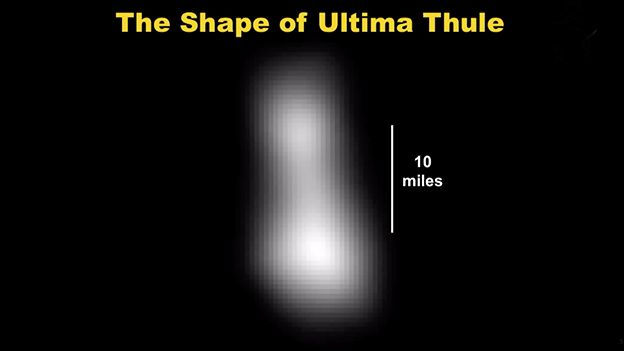
Taken from a few hundred thousand km: A last image on approach to the target
The radio message from the robotic craft was picked up by one of NASA's big antennas, in Madrid, Spain.
It had taken fully six hours and eight minutes to traverse the great expanse of space between Ultima and Earth.
Jim Bridenstine, Nasa’s chief administrator, said in a tweeted statement: “In addition to being the first to explore Pluto, today New Horizons flew by the most distant object ever visited by a spacecraft and became the first to directly explore an object that holds remnants from the birth of our solar system.
“This is what leadership in space exploration is all about.”
Hal Weaver, a research professor at Johns Hopkins University and a project scientist on the New Horizons mission, called the flyby a “once-in-a-lifetime opportunity”.
“This is another great step in the exploration of our solar system,” he said.
Thousands of photographs of the dark, icy space rock called Ultima Thule were snapped by the New Horizons probe as it barrelled past it on the outer edge of the solar system at 0533 GMT.
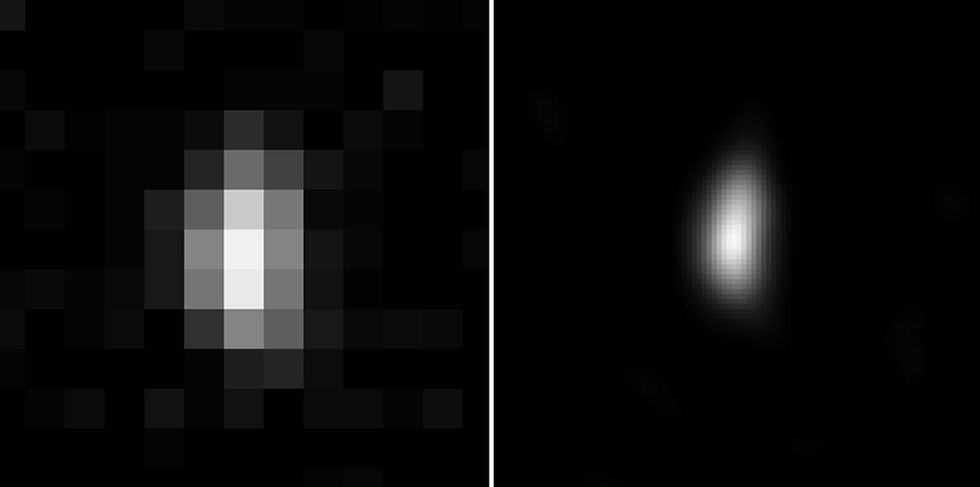
This photo of the Kuiper Belt object Ultima Thule (2014 MU69) reveals a new clue into the object's shape just ahead of New Horizons' closest approach on Jan. 1, 2019. This photo was taken on Dec. 30, 2018 by New Horizons from distance of about 1.2 million miles (1.9 million kilometers).
Credit: NASA/Johns Hopkins University Applied Physics Laboratory/Southwest Research Institute
The first images to be beamed home from Ultima Thule will be small and grainy, but a day or two after the encounter, Nasa hopes to have more impressive pictures from the probe.
The vast separation between New Horizons and Earth, coupled with the probe's small, 15-watt transmitter, mean data rates are glacial, however.
They top out at 1 kilobit per second. To retrieve all of the imagery stored on the probe is therefore expected to take until September 2020.
The first of the very highest resolution pictures are not expected on Earth until February. But this wouldn't delay the science, said Principal Investigator Alan Stern.
"The [lower resolution] images that come down this week will already reveal the basic geology and structure of Ultima for us, and we're going to start writing our first scientific paper next week," he told reporters.
Even just the final picture released from the approach phase to the flyby contained tantalising information. Ultima appears in it as just a blob, but immediately it has allowed researchers to refine their estimate of the object's size - about 35km by 15km.
It's been a long road to Ultima Thule for New Horizons.
NASA launched the $700 million nuclear-powered spacecraft in January 2006 on a mission originally aimed at Pluto. That mission was an astounding success, with New Horizons zipping by Pluto and its five moons on July 14, 2015, revealing the first-ever detailed photos of the dwarf planet.
But even before New Horizons reached Pluto (which itself is in the Kuiper Belt), mission scientists were looking to the next target. In 2014, mission scientist Marc Buie of SwRI discovered Ultima Thule (then known only by its official name, 2014 MU69) using the Hubble Space Telescope and a new destination was set.

Whats next for New Horizons
First, the scientists must work on the Ultima data, but they will also ask Nasa to fund a further extension to the mission.
The hope is that the course of the spacecraft can be altered slightly to visit at least one more Kuiper belt object sometime in the next decade.
New Horizons should have just enough fuel reserves to be able to do this. Critically, it should also have sufficient electrical reserves to keep operating its instruments into the 2030s.
The longevity of New Horizon's plutonium battery may even allow it to record its exit from the Solar System.


Comments